Key takeaways
The Charlotte metropolitan statistical area (MSA) represents one of the fastest-growing commercial ecosystems in North America. With hundreds of corporate relocations, massive infrastructure investments, and thousands of affluent households migrating annually to Mecklenburg, Union, Cabarrus, and York counties, commercial demand is at an all-time high. Yet in almost every high-margin vertical (specialty medical, commercial contracting, luxury residential services, and enterprise legal), local search results remain dominated by complacent legacy incumbents.
These legacy businesses rely on domain age and historical review volume rather than modern technical optimization. By deploying a systematic competitive displacement strategy, agile challengers can overtake these incumbents in under 12 months. Dominating the Queen City requires an engineered local framework: analyzing competitor geo-grid vulnerabilities, constructing hyper-localized suburban content hubs, optimizing for the North Carolina and South Carolina border corridor, and building authoritative Carolinas institutional entity graphs.
1. The Queen City Boom: Why Charlotte Is America's Most Lucrative Local SEO Battleground
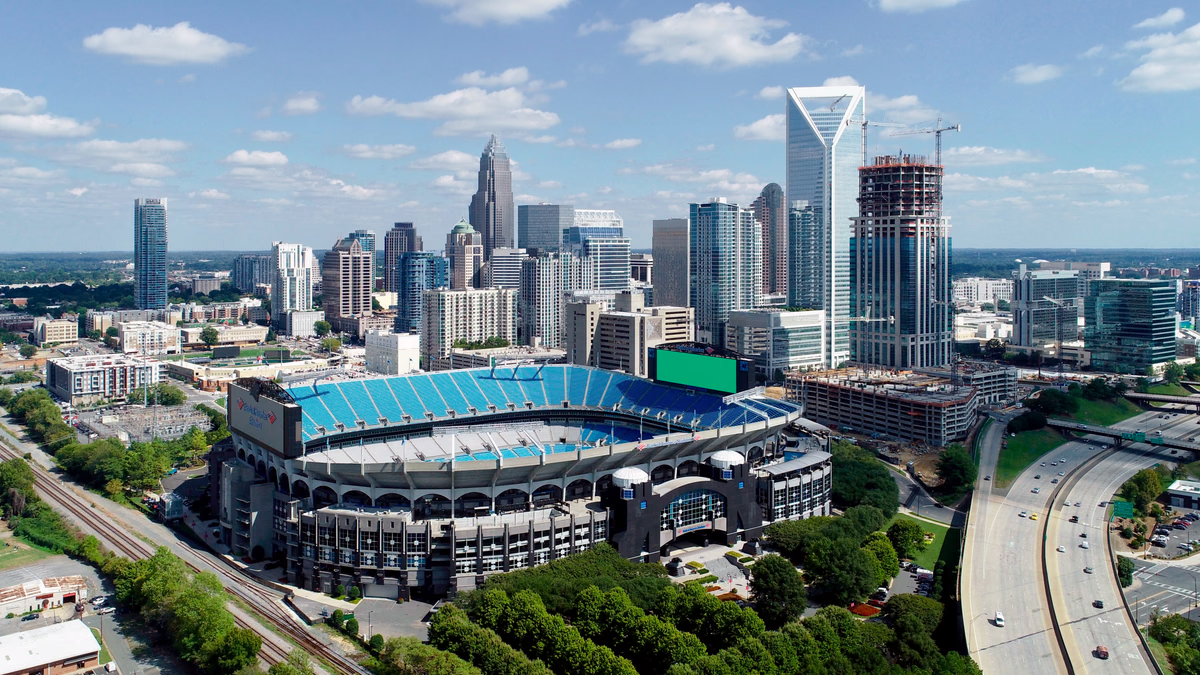
Charlotte is not an ordinary regional market. As the second-largest financial hub in the United States, home to major commercial banking institutions and energy corporations, the region possesses extraordinary wealth density and continuous corporate capital inflow.
However, this rapid influx has created massive friction in local search engine results pages:
Inflow of Wealthy Consumers
Affluent suburban enclaves (SouthPark, Myers Park, Ballantyne, Lake Norman) exhibit enormous search volumes for premium high-ticket services.
Complacent Legacy Incumbents
Established businesses that have operated for 25+ years often neglect modern technical SEO, leaving massive architectural gaps in their digital defenses.
Private Equity Trade Rollups
Institutional investors are actively buying regional trade and medical firms, injecting capital to displace independent family-owned practices.
"In a market absorbing 100+ new residents daily, historical reputation alone cannot sustain market leadership. The newcomer who dominates the mobile local 3-pack captures the customer before the legacy brand even knows the search occurred."
2. The Displacement Audit: Exploiting Technical Flaws in Legacy Incumbent Profiles
Before launching an offensive local SEO campaign, we conduct forensic vulnerability audits on the top-3 ranking competitors in your primary trade category across Mecklenburg County.
Most legacy leaders suffer from predictable technical vulnerabilities:
| Vulnerability Class | Observed Incumbent Anti-Pattern | Algorithmic Weakness | The OVERTOP Offensive Displacement Protocol |
|---|---|---|---|
| Stagnant Review Velocity | 1,200 reviews, but only 2 new reviews received in the past 90 days. | Google's algorithm prioritizes recent review freshness over static lifetime counts. | Deploy automated SMS post-service review triggers to generate 25+ fresh 5-star ratings monthly. |
| Spammy Business Names | Stuffing city names into GBP titles (e.g., 'Smith HVAC Charlotte NC Best Air Repair'). | Violates Google Business Profile guidelines, vulnerable to algorithmic name strikes. | Submit official redressal forms with state corporate registry proof while ranking cleanly on entity authority. |
| Thin Doorway City Pages | Identical city pages across 20 suburbs with only the city name replaced. | Triggered by Google's Doorway Page algorithm, resulting in complete suburban de-indexing. | Engineer authentic neighborhood hubs featuring local red clay challenges, municipal permit guidelines, and real job photos. |
| Missing Structured Data | Zero Schema.org entity markup or generic organization schema. | Search bots cannot verify licensing, 24/7 operating hours, or service radii. | Inject nested LocalBusiness, openingHoursSpecification, and state board licensing credentials. |
The Business Redressal Protocol: Purging Competitor Name Spam
In Charlotte's competitive service sectors, entrenched competitors frequently manipulate Google Business Profile titles by injecting unauthorized keywords (e.g., changing "Smith Plumbing" to "Smith Plumbing Charlotte Emergency Plumber Near Me").
Under Google's Merchant Guidelines, adding promotional descriptors or geographic modifiers to business titles is explicitly prohibited.
By documenting legal corporate registrations through the North Carolina Secretary of State and submitting formal Google Business Redressal Complaint Forms, we systematically eliminate artificial ranking advantages, restoring a clean competitive playing field (a displacement tactic equally vital in hyper-local storage asset marketing; see our analysis on Self-Storage Facility Local SEO & Occupancy Playbook).

3. Geo-Grid Modeling: Expanding Your Proximity Halo Across Mecklenburg County
When a homeowner in Huntersville, a resident in Stallings, a business owner in Albemarle, Locust, Bessemer City, Cramerton, a college-town entrepreneur in Davidson, a riverfront operator in Belmont, an estate provider in Weddington, or a lakeside business owner in Tega Cay conducts a local search, proximity algorithms evaluate physical distance.
Similarly, when queries originate from a manufacturer in Newton, an industrial operator in Gaffney, a contractor in Lincolnton, an enterprise in Kings Mountain, a healthcare practice in Pineville, a municipal firm in York, a residential provider in Wesley Chapel, an industrial business in Lancaster, or a manufacturing company in Conover, search engines assess local relevance signals before awarding map pack positions.
The same proximity dynamics govern commercial searches from a service contractor in Clover, a property specialist in Unionville, an equestrian estate owner in Marvin, a commercial manufacturer in Cherryville, a collegiate facility in Dallas, an industrial enterprise in Mocksville, a commercial contractor in Long View, a manufacturing facility in Chester, a trade specialist in Midland, or an enterprise buyer in the Charlotte metro core.
To expand beyond a tight 3-mile proximity circle and displace established competitors 15 miles away, companies must build a multi-layered Proximity Halo Expansion Architecture:
Hyper-Local Neighborhood Hubs
Dedicated landing pages for South End, NoDa, Dilworth, Plaza Midwood, SouthPark, and Ballantyne with unique civic content.
Geo-Tagged Customer Testimonials
Reviews citing specific local landmarks, intersecting streets, and neighborhood communities to feed proximity relevance.
Regional Service Radius Schema
Explicit GeoCircle coordinates and Wikidata entity links covering all 48 Mecklenburg and surrounding metro zip codes.
Dynamic Transit Anchoring: Directions from Major Thoroughfares
To strengthen geographic proximity signals without triggering door-page spam algorithms, every neighborhood hub page must detail physical driving routes from major Charlotte thoroughfares (e.g., Independence Boulevard, South Boulevard, Providence Road).
Describing parking availability, nearby intersections, and public transit connections provides authentic utility to local consumers while providing semantic geographic context to search engines.
4. The High-Yield Suburbs: Dominating Lake Norman, Union County & Fort Mill Corridors
The greatest commercial profit margins in the Charlotte region reside outside the center city in high-income suburban belts:
- The Lake Norman Corridor (Cornelius, Davidson, Mooresville): High-net-worth waterfront properties requiring high-end HVAC, custom construction, luxury cosmetic medicine, and marine trade services.
- The South Charlotte & Union County Belt (SouthPark, Ballantyne, Waxhaw, Weddington): Corporate executives demanding premier residential services, private medical specialists, wealth management, and elite private academies (see our enrollment strategy on Private School & Higher Ed Local SEO).
- The Interstate 77 South Corridor (Fort Mill, Rock Hill, Tega Cay, SC): Rapidly expanding commercial logistics and family developments that straddle state lines.
Navigating the North Carolina and South Carolina Border Dilemma
Businesses operating in the southern Charlotte metro must serve both North Carolina and South Carolina customers. However, crossing state lines introduces regulatory licensing complexities.
By structuring dual-state licensing credentials directly within Schema.org entity graphs, your business proves legal authority to practice on both sides of the state border, outranking single-state competitors.
Interstate Transit Topologies: I-77, I-85 & I-485 Beltway Modeling
Customer transit patterns across Mecklenburg County are dictated by major interstate expressways.
The Interstate 485 outer beltway connects decentralized suburban population nodes (Pineville, Matthews, Mint Hill, University City, Huntersville).
Structuring content around expressway exits and regional commute corridors matches real-world driving behavior, capturing searchers navigating between suburban bedroom communities and employment centers.
5. Carolinas Ground Truth: Weaving Localized Soil, Water & Climate Realities into Copy
Search algorithms increasingly penalize generic content written by national content farms that know nothing about local Carolinas conditions.
To rank at the top of local search results, your content must incorporate authentic regional technical realities:
- Carolina Red Clay Soil Friction: For foundation repair, plumbing excavation, and commercial grading contractors, explaining how red clay expands and contracts during humid summers establishes authoritative technical relevance.
- Charlotte-Mecklenburg Water Quality & Hardness: Plumbing and water treatment pages addressing specific mineral levels (Piedmont Piedmont surface water hardness averages 25 to 40 mg/L) convert educated property owners immediately.
- Piedmont Humid Subtropical Heat Pump Optimization: HVAC guides breaking down high-humidity summer latent heat loads vs winter freezing rain conditions.
Mecklenburg County Historic Districts & Tree Canopy Ordinances
Charlotte's premier historic neighborhoods (Dilworth, Fourth Ward, Plaza Midwood, Myers Park) enforce strict historic district commission standards and municipal tree protection ordinances.
Contractors who publish detailed guidance on navigating Charlotte historic commission design reviews or working beneath protected willow oak canopies demonstrate unmatched hyper-local expertise.
These specialized civic insights differentiate your company from generic national competitors, cementing lasting trust with affluent local homeowners.
6. Interactive Calculator: Charlotte Regional Market Proximity & Geo-Grid Displacement Simulator
Model your business's presence across Mecklenburg and surrounding Carolina counties below to project inbound lead expansion and gross revenue growth from systematically displacing legacy competitors.
Charlotte Market Geo-Grid Displacement Simulator
Model target suburban corridors, evaluate displacement efficiency, and project annual gross revenue expansion.
7. The Carolinas Citation Ecosystem: Building Authoritative Regional Trust Signals
Google's local algorithms place tremendous weight on citations and unstructured mentions from respected regional and state institutions.
To cement regional authority and displace entrenched competitors, we build authoritative connections with trusted North Carolina entities:
Civic & Business Alliances
Verified memberships and profile placements with the Charlotte Regional Business Alliance and regional suburban chambers.
State Board Registries
Direct structured data entity links to the North Carolina Secretary of State and relevant state licensing boards.
Regional Media Placement
Earned editorial features in the Charlotte Business Journal, Business North Carolina, and regional news publications.
8. Review Velocity Acceleration: Outpacing Incumbent Review Stagnation
A common trap in local search is believing that an established competitor with 800 reviews cannot be overtaken.
In reality, Google's algorithm heavily prioritizes review recency, response rates, and keyword relevance over static lifetime review counts. A competitor with 800 reviews who averages only 1 new review per month is highly vulnerable to a challenger generating 20 fresh reviews per month.
Within 6 to 9 months, the challenger's active review velocity signals superior current popularity and customer satisfaction, prompting Google to elevate their profile into the top-3 local pack.
Review Response Personalization & Local Keyword Sentiment
Replying to 100% of customer reviews within 24 hours reinforces brand trustworthiness and signals active owner engagement to search engine crawlers.
When responding, naturally affirming specific service categories and Charlotte neighborhood locations (e.g., "Thank you for trusting our team with your SouthPark water heater installation") enriches profile semantic relevance without triggering spam filters.
9. Multi-Jurisdictional Entity Schema: Connecting NC and SC Licensing Records
For businesses serving both the Charlotte urban core and northern South Carolina communities, search engines require explicit proof of dual-state operations.
We inject multi-jurisdictional schema markup that links corporate entities to both North Carolina and South Carolina regulatory registries:
<script type="application/ld+json">
{
  "@context": "https://schema.org",
  "@type": "LocalBusiness",
  "@id": "https://overtopmedia.com/#carolinas-corp",
  "name": "Carolina Metro Services",
  "telephone": "+1-704-237-0707",
  "address": {
    "@type": "PostalAddress",
    "streetAddress": "933 Louise Ave Suite 101-18",
    "addressLocality": "Charlotte",
    "addressRegion": "NC",
    "postalCode": "28204",
    "addressCountry": "US"
  },
  "areaServed": [
    {
      "@type": "AdministrativeArea",
      "name": "Mecklenburg County, NC",
      "sameAs": "https://www.wikidata.org/wiki/Q509670"
    },
    {
      "@type": "AdministrativeArea",
      "name": "York County, SC",
      "sameAs": "https://www.wikidata.org/wiki/Q498263"
    },
    {
      "@type": "City",
      "name": "Charlotte",
      "sameAs": "https://www.wikidata.org/wiki/Q16565"
    },
    {
      "@type": "City",
      "name": "Fort Mill",
      "sameAs": "https://www.wikidata.org/wiki/Q925579"
    }
  ]
}
</script>
10. Sub-100ms Edge Performance: Eliminating Mobile Friction for Queen City Searchers
Over 78% of local service inquiries in the Charlotte area occur on mobile devices. Whether searching from a vehicle on Interstate 485 or from a residence in SouthPark, slow page load speeds kill conversion rates.
Legacy websites loaded down with bloated WordPress plugins typically exhibit mobile load times between 3.5 and 6.0 seconds.
By migrating to pre-compiled static assets deployed across a global edge network, your pages achieve sub-100ms response times and perfect Core Web Vitals scores, providing a massive algorithmic ranking advantage.
Next-Gen Responsive AVIF Delivery Across Mobile Networks
High-resolution photography showcasing local work can rapidly degrade mobile page speed if delivered as uncompressed legacy JPEGs.
By utilizing modern next-generation image encoding (serving ultra-efficient AVIF and WebP variants inside responsive <picture> elements), page payloads drop by up to 80% without sacrificing visual crispness.
Local searchers on cellular networks experience instant visual rendering, slashing bounce rates and signaling intense user satisfaction to Google's ranking algorithms.
11. Corridor Expansion: Linking Uptown, Airport & University Research Parks
Commercial enterprises seeking regional growth must systematically establish topical and geographic authority across Charlotte's three primary economic hubs:
- Uptown Financial Center: High-density corporate offices, headquarters facilities, and financial institutions requiring white-glove professional services.
- Charlotte Douglas International Airport (CLT) Logistics Corridor: Warehousing, advanced manufacturing, and commercial logistics along Interstate 85.
- University Research Park & Innovation Corridor: Technology enterprises, biomedical research centers, and academic institutions in Northeast Mecklenburg.
LYNX Blue Line Transit-Oriented Development (TOD) Corridors
The Charlotte Area Transit System (CATS) LYNX Blue Line light rail corridor has transformed urban development from Pineville through South End to UNC Charlotte.
High-density mixed-use developments along rail transit stations concentrate thousands of affluent millennial and executive households who prioritize walkability.
Optimizing for specific light rail station nodes (e.g., Bland Street, East/West Boulevard, 36th Street in NoDa) targets high-intent local consumers seeking services within walking distance of transit stops.
12. Enterprise Case Study: Displacing a 30-Year Incumbent to Capture $2.4M in New Contracts
To examine the immense power of an engineered displacement strategy, consider the campaign executed for a Charlotte-based commercial mechanical and facility contractor.
The contractor was struggling to rank against a 30-year legacy incumbent that maintained over 1,500 reviews and dominated the local 3-pack for high-value terms like "commercial HVAC contractor Charlotte".
The Baseline Diagnostic Audit:
- Zero Local Presence in Lake Norman & Fort Mill: The incumbent ranked well in central Charlotte, but their geo-grid visibility dropped to zero beyond an 8-mile radius.
- Review Stagnation: The incumbent had received only 4 reviews over the preceding 12 months, signaling operational complacency.
- Thin, Outdated Website: The incumbent's website had not been updated since 2017, suffered from poor mobile formatting, and lacked structured schema markup.
The OVERTOP Strategic Remediation:
- Forensic Competitor Geo-Grid Mapping: Mapped the incumbent's proximity drop-off zones across 14 suburban zip codes.
- High-Density Neighborhood Content Architecture: Deployed 12 authentic suburban landing hubs complete with municipal permitting standards and verified jobsite photos.
- Automated Review Generation Engine: Integrated mobile dispatch review webhooks, generating 28 fresh 5-star customer reviews every month.
- Edge Infrastructure Migration: Cut mobile page load times from 4.8 seconds to 120 milliseconds.
The 12-Month Displacement Results:
- Achieved #1 Local Pack Position in 9 Targeted Suburbs: Displacing the legacy incumbent across Huntersville, Cornelius, SouthPark, and Ballantyne.
- 320% Increase in Commercial Inbound Phone Calls: Generating over 140 qualified commercial facility manager inquiries.
- $2,420,000 in Attributed Gross Contract Value: Capturing major corporate tenant buildout contracts and annual commercial service agreements.
13. Frequently Asked Questions About Charlotte Local SEO & Market Displacement
Why is the Charlotte, North Carolina market uniquely competitive for local search?
Charlotte represents the second-largest banking center in the United States and has absorbed over 100 net new residents daily for the past decade. This explosive population growth has attracted immense private equity investment into local trade enterprises, healthcare practices, and professional services. Legacy incumbents who previously relied on historical word-of-mouth are being rapidly displaced by agile competitors armed with programmatic geo-grid architectures, review velocity automation, and nested schema graphs.
What is competitive displacement in local SEO?
Competitive displacement is an offensive local search methodology designed to systematically strip market share and top-3 Google Map Pack positions from entrenched competitors. It audits incumbent technical weaknesses (e.g., keyword stuffing vulnerabilities, unverified secondary addresses, missing schema markup, and stagnant review velocity) and deploys superior localized entity signals to claim their ranking real estate.
How do you optimize for Charlotte's surrounding regional suburban corridors without triggering spam filters?
Dominating high-growth suburban corridors (such as Lake Norman, Huntersville, Ballantyne, Fort Mill, and Matthews) requires building dedicated geographic hubs rooted in authentic community data. Avoid generic doorway templates; instead, incorporate municipal zoning ordinances, local infrastructure projects, neighborhood landmarks, and geo-tagged jobsite photography.
How does physical address proximity influence rankings across Mecklenburg County?
Google's proximity-bias algorithm creates an organic 'ranking halo' around your physical business address. In a sprawling metropolitan area like Mecklenburg County (spanning over 540 square miles), a single business address in Uptown will struggle to rank in Ballantyne or Lake Norman on proximity alone. Expanding this halo requires engineering high-density localized content clusters, regional co-citations, and authentic neighborhood customer testimonials.
What role do local authority backlinks play in North Carolina search rankings?
Backlinks from local civic institutions, regional media outlets (e.g., Charlotte Business Journal, Charlotte Observer), local chambers of commerce (Charlotte Regional Business Alliance), and accredited Carolinas trade associations carry immense regional trust weight in Google's localized entity graph algorithms.
How does Google evaluate multi-state border markets like Charlotte and Fort Mill, South Carolina?
The Charlotte metropolitan area spans the North Carolina and South Carolina border. To rank effectively across both states, businesses must structure clear multi-jurisdiction schema graphs, declare licensure across both state licensing boards, and map regional service areas explicitly using Wikidata entities for both states.
Keep reading.
 Local market strategy Charlotte Business SEO Strategy Guide Entity optimization, local citations, Google Business Profile rankings, and high-growth Carolina positioning. Read the guide
  Data governance Local Citation Audits & NAP Consistency Aggregator API syndication, duplicate suppression, and cross-platform listing governance. Read the guide
  Trade fleet dispatch HVAC & Plumbing Emergency SEO Playbook Dispatch clustering, 24/7 service-area schema graphs, and rapid sub-3-ring call routing. Read the guide
 Ready to Displace Complacent Competitors and Command the Local 3-Pack?
Do not allow legacy competitors to hold your business back in the fastest-growing market in the Southeast. Partner with Charlotte's premier digital performance agency to engineer a high-impact local search architecture, expand your proximity radius, and capture dominant market share.